Dog Years Calculator
A size-adjusted, veterinary-based converter — not the outdated "1 year = 7 human years" myth. Instant, private, offline-ready.
Age Converter
Choose a direction and breed size, then enter the age.
Equivalent
28.0 human-equivalent years
Life stage
Mature adult
Size adjustment
Medium
Share this conversion: My dog is 28.0 in human years (Mature adult)
Definition: Dog years is a conversion of a dog’s calendar age into a human-equivalent age; the familiar “multiply by 7” rule is folklore, not veterinary science.
Quick answer: How old is my dog in human years?
Canine ageing is front-loaded, not linear: a dog's first year is roughly equivalent to 15 human years, the second adds about 9 more (around 24), and each year after that adds roughly 4–5 human years, faster for larger breeds.
Size matters more than most conversions admit. At 10 calendar years a small dog under 9 kg is broadly comparable to a human in their mid-fifties, while a giant breed over 45 kg is closer to a human in their late seventies. Treat any single number as an estimate — this page states its factors openly rather than hiding them behind a single multiplier.
Last updated · All figures on this page are produced by the same calculation engine as the calculator above.
The 7-year rule is wrong — here's why it stuck
The "one dog year equals seven human years" shortcut appeared in print in the 1950s and spread because it's easy to say. It's built on a single averaged assumption: dogs live around 10 years, humans around 70, so multiply. That's it. The math has almost nothing to do with how either species actually ages.
Real aging is front-loaded for dogs. A puppy hits sexual maturity in under a year and reaches an adult body by two. By dog age two, a medium breed is already roughly a 24-year-old human. After that, the curve flattens — each subsequent year adds four to six human-equivalent years, not seven, and the exact number depends on breed size.
What makes this calculator different
- • Size-adjusted. Four breed bands, each with its own aging curve — not one flat multiplier.
- • Bidirectional. Convert dog → human, or human → dog, from the same page.
- • Life stage included. Puppy, adult, senior, geriatric — the label vets actually use.
- • Based on published data. AVMA guidance plus the 2019 epigenetic-clock study, not a 1950s rule of thumb.
How breed size changes the picture
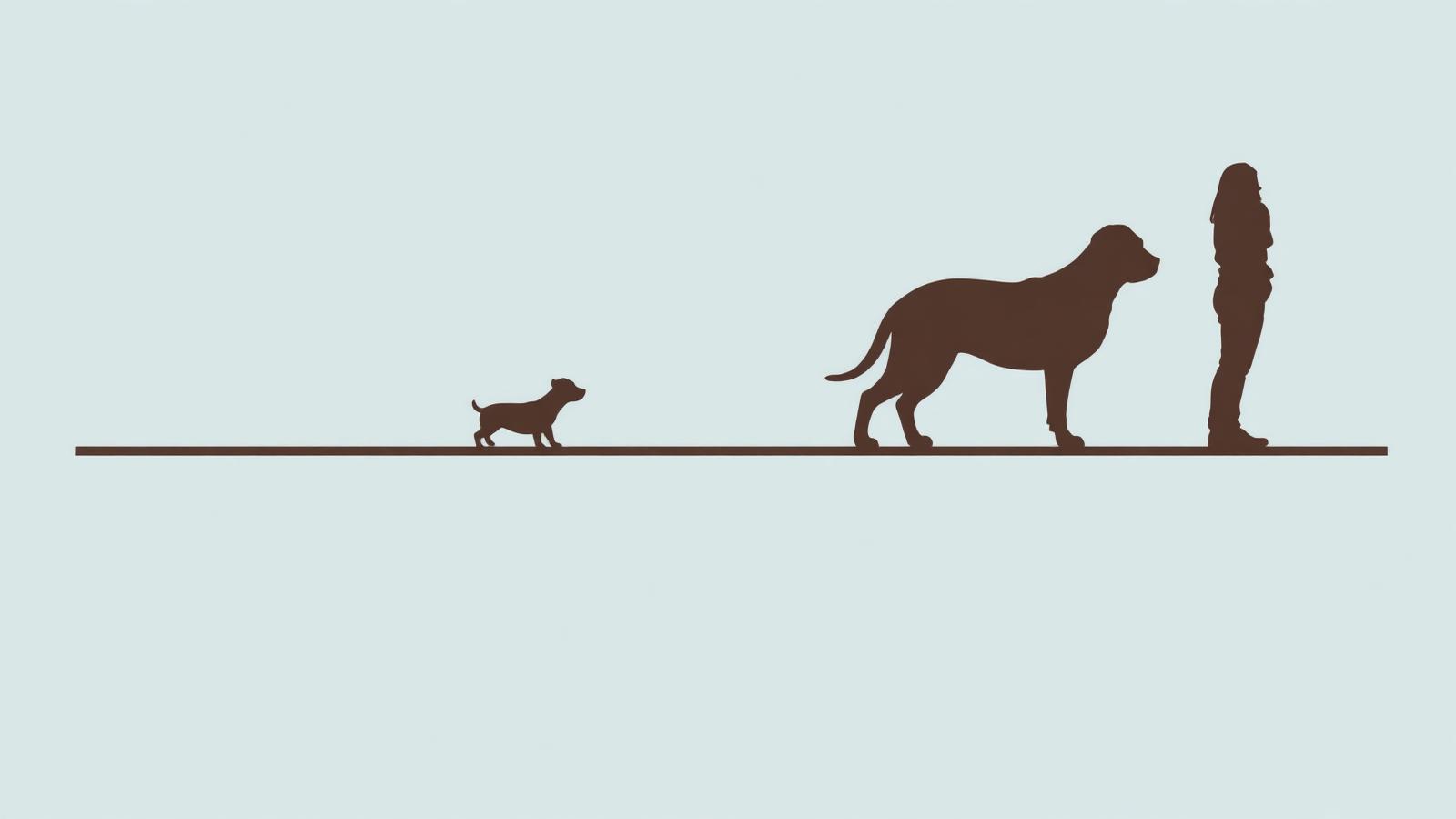
Larger dogs age faster in the second half of life. A seven-year-old small breed is roughly 44 human years; the same age in a giant breed lands closer to 56. By ten, the gap widens: 56 for a small breed against 79 for a giant. That's why a Great Dane is considered senior at six, while a toy poodle isn't senior until nine or ten.
A quick reference (medium breed)
- 1 dog year ≈ 15 human years
- 2 dog years ≈ 24 human years
- 5 dog years ≈ 37 human years
- 10 dog years ≈ 60 human years
- 15 dog years ≈ 83 human years
Adjust these up for larger breeds and down for smaller ones — the calculator above does it automatically.
Curious about your own numbers? Try the billion-seconds milestone or total days alive — same calm, same privacy, just aimed at humans.