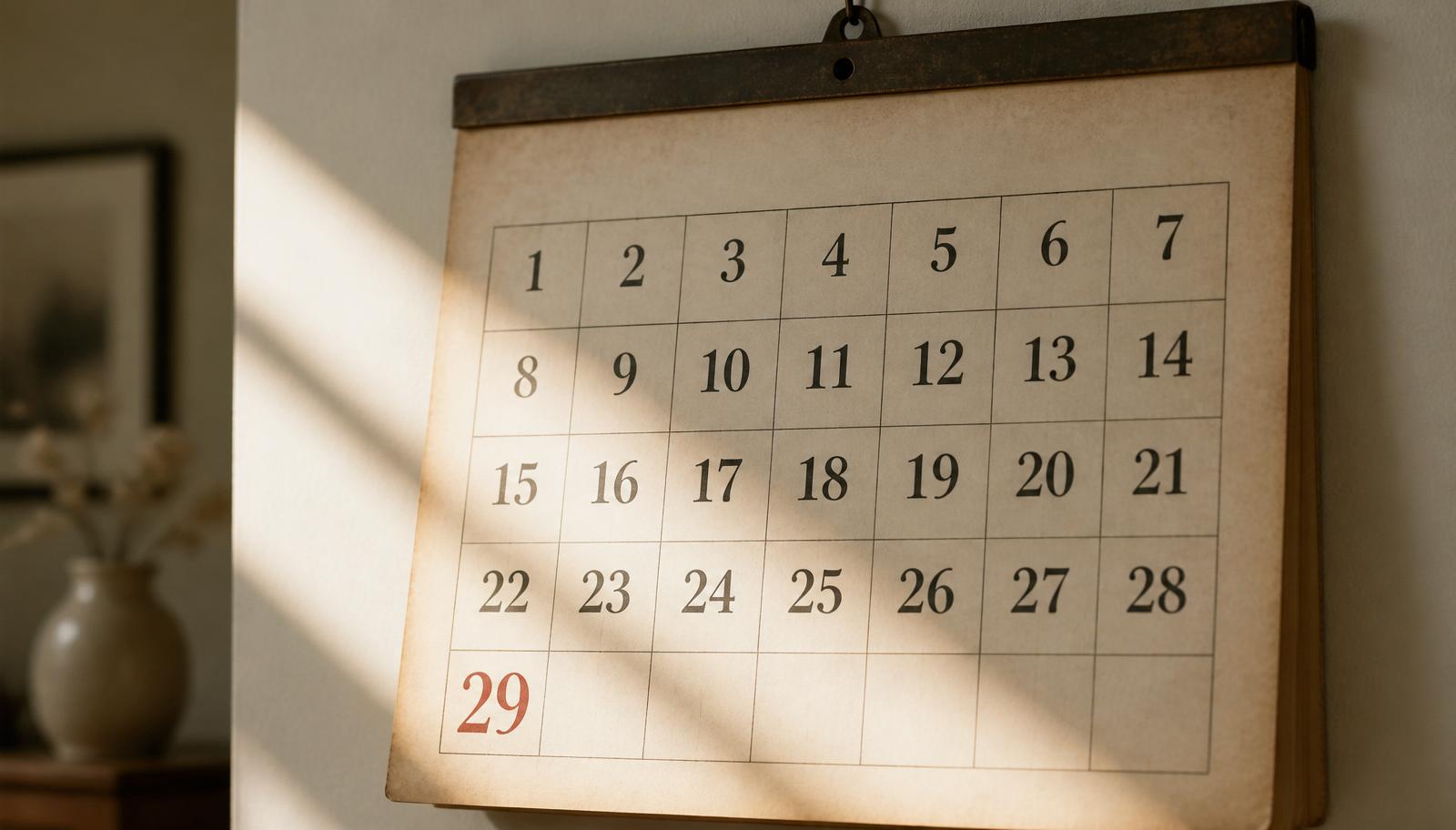
Leap Year Birthday Calculator
Exact age for leaplings, the correct day to celebrate on in common years, and a countdown to your next real February 29. Works for any birth date — not just Feb 29.
Calculate Your Leap Year Birthday
Runs entirely in your browser — nothing is stored or sent.
Celebration convention (common years)
Definition: Leapling is a person born on 29 February, a date that exists only in leap years and therefore returns roughly once every four years.
Quick answer: When does someone born on 29 February turn a year older?
On 1 March in common years, and on 29 February in leap years. A leapling born 29 February 2004 completes 23 full years on 1 March 2027 — on 28 February 2027 they are still 22 years, 11 months and 30 days old.
This is a legal convention, not arithmetic: England and Wales, Hong Kong and New Zealand treat 1 March as the day the year is completed, while Sweden and Taiwan name 28 February instead. SnapAgeCalc applies the 1 March rule consistently across every calculator on this site, so figures never contradict each other.
Last updated · All figures on this page are produced by the same calculation engine as the calculator above.
Method: exactly how the age is calculated
SnapAgeCalc uses the Western (calendar) convention: age is the number of complete years, then complete months, then whole days elapsed between the date of birth and the target date. Nothing is rounded up.
- Completed years: count full anniversaries passed. A person born 1 July 1990, measured on 30 June 2026, is 35 — not 36.
- Completed months: from the last birthday, count full calendar months. Month lengths are used as they actually are (28–31 days), never averaged to 30.
- Remaining days: the whole days left after years and months are removed. Partial days are truncated, never rounded up.
- Totals: total days, weeks, hours, minutes and seconds are measured directly between the two timestamps, independent of the years/months breakdown.
- Leap years follow the Gregorian rule: 2096 is a leap year, 2100 is not, so the gap between two consecutive 29 Februarys can be eight years rather than four.
Leap years, month lengths and date assumptions
- Leap years follow the Gregorian rule: divisible by 4, except centuries, unless divisible by 400. 2000 was a leap year; 1900 and 2100 are not.
- For a 29 February birth date in a common year, the calculator treats 1 March as the day the next full year is completed — the legal convention in most jurisdictions, including the UK and most US states.
- If a target day-of-month does not exist in the target month (for example 31 in February), the calculation clamps to the last valid day of that month.
- When no time of day is supplied, birth is assumed to be at 00:00 local time and the comparison is made in your device's local timezone.
Limitations
- Results are chronological age only. They are not a measure of biological, developmental or corrected age.
- East Asian age reckoning (where a person is 1 at birth) is not used. Those systems can differ from the result here by one or two years.
- Crossing timezones or daylight-saving boundaries can shift hour-level totals by up to one hour. Year, month and day figures are unaffected.
- Leap seconds are ignored, as they are unpredictable for future dates.
- The celebration date shown is the arithmetic and legal convention, not advice on any specific statute — check local law where an exact birthday date carries legal effect.
Method last reviewed . Calculations run entirely in your browser; no birth date is transmitted or stored.
What actually counts as a leap year?
A leap year in the Gregorian calendar is any year that satisfies all three of these rules:
- Divisible by 4, and
- Not divisible by 100, unless
- Also divisible by 400.
That's why 2000 was a leap year but 1900 was not — and why 2100, 2200, and 2300 will all skip Feb 29 before 2400 brings it back. The rule keeps the calendar aligned with Earth's orbit of about 365.2422 days, drifting only about one day every 3,236 years.
Quick check
- 2020, 2024, 2028, 2032 — leap years (divisible by 4, not by 100)
- 2000, 2400 — leap years (divisible by 400)
- 1900, 2100, 2200, 2300 — not leap years (divisible by 100, not 400)
When do leaplings celebrate in common years?
Because Feb 29 only exists three years out of four, leaplings need a fallback. There is no universal rule — the country you're in and, sometimes, the specific document you're dealing with (driver's licence, insurance policy, prison-release date) decides for you.
| Jurisdiction | Legal birthday in common years |
|---|---|
| United Kingdom | March 1 |
| Hong Kong | March 1 |
| New Zealand | March 1 |
| Sweden | February 28 |
| Taiwan | February 28 |
| United States | Varies by state; most default to March 1 for age-of-majority purposes |
| Canada / Australia | Not codified; either date is accepted culturally |
The practical takeaway: your chronological age — the number this calculator shows — is the same either way. Which day you throw the party on, and which day the state considers you a year older for eligibility purposes, are separate questions.

How age is calculated when your birthday doesn't exist
Age math for leaplings is not special. Your chronological age is still years since birth, measured against the current date. The only question is when you tick over — and most computer systems (including this one) use one of two conventions:
- Anniversary-strict: you become one year older on the anniversary of your birth date. Because Feb 29 doesn't exist in common years, systems fall back to either Feb 28 or Mar 1 based on locale settings.
- Elapsed-days: you become one year older after 365.2425 days have elapsed. This gives the same integer result 99% of the time, and is what banking/insurance systems tend to use.
This calculator uses the anniversary-strict convention and lets you choose the fallback date. If you need year/month/day precision (developmental testing, medical dosing), our chronological age calculator produces the exact three-column result.
Leap-day trivia most calculators get wrong
- A person born February 29, 1896 waited until 1904 for their next real birthday — 1900 was skipped because it wasn't divisible by 400.
- The odds of being a leapling are 1 in 1,461, not 1 in 1,460 — the four-year cycle has 1,461 days total.
- The oldest active leap-day club is The Honor Society of Leap Year Day Babies, founded in 1997.
- A leapling turning 21 has typically only had 5 real Feb 29 birthdays (ages 4, 8, 12, 16, 20) — depending on whether their birth year was itself a leap year.